
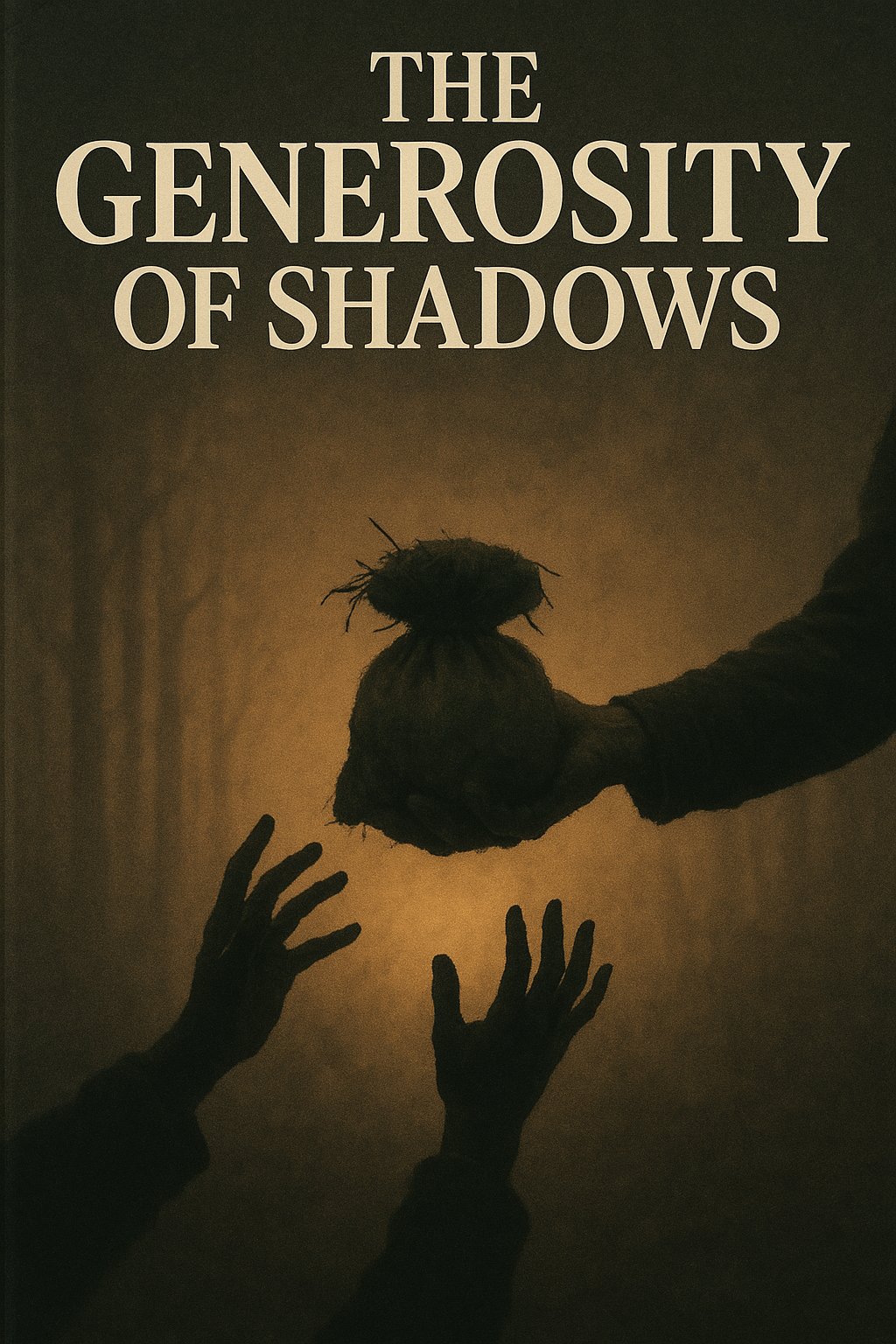

“What is taken by force, we call theft. What is taken with a smile, we call duty.”
The Woodhollow
Tale
The logging town of Woodhollow lay quietly amid a dying forest. It used to be full of life, but now it looked as empty and tired as the trees around it. The wind sighed through brittle branches, and chimneys exhaled no more than wisps of smoke—barely alive, like the people themselves. The townsfolk huddled in thick, patched cloaks, their faces lean and grey, dragging bundles of twigs and dulled axes behind them. Once lush and endless, the forest now stood like a skeleton grove—stripped bare, overworked, and weary.
At the centre of town stood a Timber
Throne, carved from a massive ironwood trunk that was said to have taken a
hundred men and a hundred days to fall. Upon it sat Lord Thornewood,
the proclaimed Guardian of the Grove, adorned in robes of green velvet stitched
with golden leaves. His guards, cloaked in fur and bound in iron, stood beside
him, motionless as statues.
Lord Thornewood had recently
doubled the wood quotas demanded from the people. Their lives crumbled under
the weight of his demand. Homes sat in ruin, holes patched with moss and cloth.
Fires remained unlit in many hearths—not from neglect but from the absence of
wood. All the timber—every splinter—went to Lord Thornewood. Eventually, the silence
of Woodhollow broke. They decided to speak.
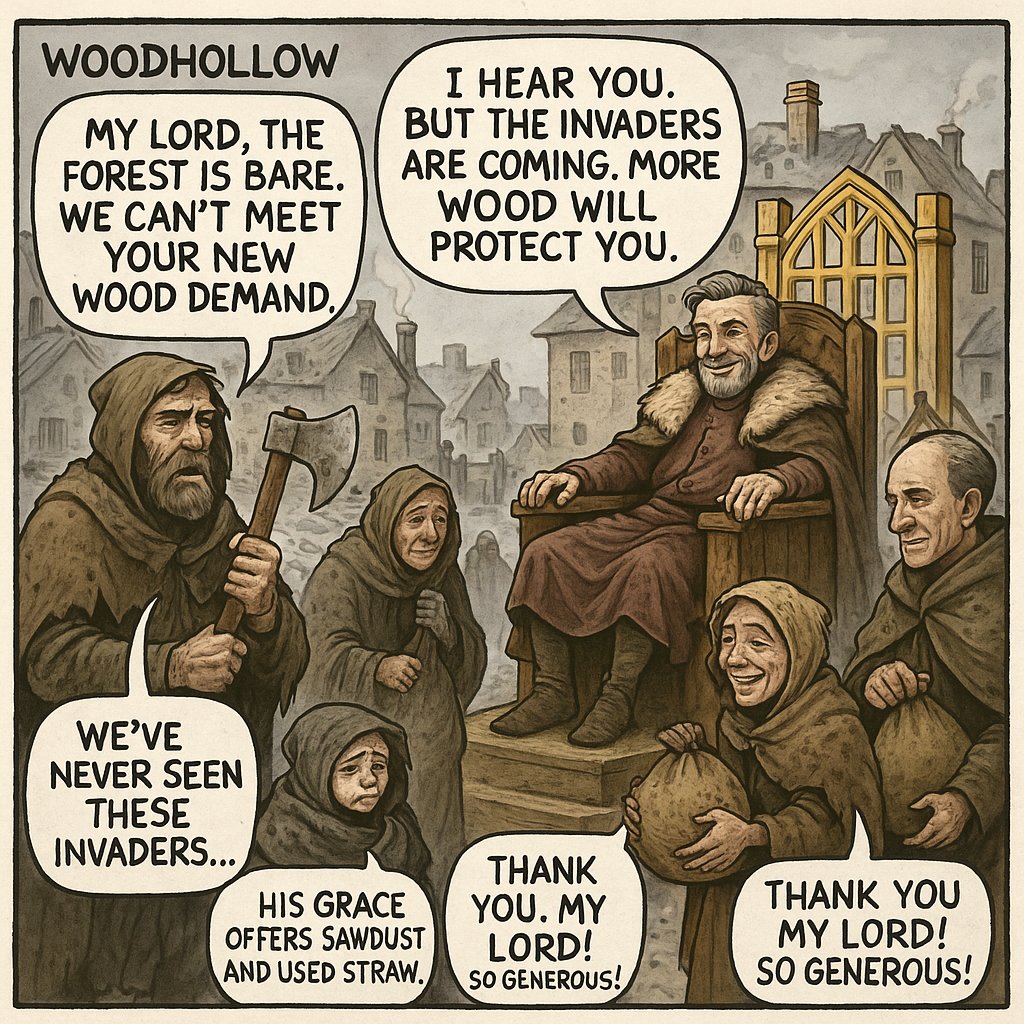
Bram, a weary man with calloused hands and a broken axe, stepped forward
and bowed low, “My Lord, the forest is thinning. We can barely find wood to
meet your new demand.”
Elsa, shivering and clutching her child to her chest, added, “We sleep
in the cold because there’s no wood left for our homes. Please… lower the
quota—or at least, let us keep enough to build shelters.”
Lord Thornewood smiled with eerie calm, resting his fingers on the carved arms of
his throne; “I understand your pain. Truly. But, the invaders are coming. If you
don’t bring more wood to me, you’ll not be protected when they arrive.”
Bram furrowed his brow, his voice low, and whispered, “But… we’ve never seen these
invaders. Not once.”
Thornewood’s tone sharpened; “The invaders work in silence. You wouldn’t know they’re here
until it’s too late.”
Merrick, the Lord’s steward, stepped forward and dropped dusty bundles into
waiting arms. “His Grace has spared some used straw and sawdust from his own sawmill.
Accept his kindness with gratitude,” he says.
Willa smiled, clutched her sack and said, “Thank you, my Lord! So
generous!”
Bram leaned closer to Elsa and whispered, “But he builds new
palaces every season... with the wood we cut.”
Before she could respond, Garrin,
one of the few who still believed, spoke out firmly; “Don’t be ungrateful.
Other towns have it worse. At least we get something.”
Lord Thornewood reclined on his throne, lifting a goblet of pineberry wine—rare and sweet, brewed from trees no one else could touch. “You have the best life in the realm. Don’t forget it. And beware—beyond Woodhollow, the towns are cursed, and no one will protect you there,” he said.
And so, the people gave more, lived with
less, and thanked the one who took the most—because he gave back just enough to
keep them believing.
Beneath the Timber Throne
“They rob
you of everything, then give back a crust—and you thank them for it.”
The quiet desperation in Woodhollow
paints a stark picture of power dynamics masked by apparent kindness. Lord
Thornewood, seated upon his lavish Timber Throne, embodies a subtle form of
control that operates not through overt oppression but through carefully
managed false generosity. His gifts of sawdust and straw, symbolic tokens
rather than substantive social change, highlight a critical truth: appearances
can mask exploitation, ensuring compliance and dependency among the townsfolk.
Woodhollow’s tale is an allegorical
reflection of the broader societal realities where those in power leverage
minimal concessions to maintain control and silence dissent. Such dynamics
occur widely in politics, business, and everyday social interactions, often
cloaked in rhetoric of benevolence. This phenomenon is evident in systems that
offer no real reforms but rely on manipulation to create the illusion of change
and progress—a psychological strategy of pacification through symbolic
gestures.
The dynamic echoes what Paulo Freire
describes as "false generosity," wherein oppressors offer superficial
benefits that do not alter systemic inequalities but foster gratitude and
dependency. Similarly, Antonio Gramsci's "cultural hegemony" theory
explores how powerful groups subtly impose their values, ensuring continued
control without overt force.
The allegorical tale of Woodhollow
illustrates a concept known as Oppressor’s Generosity—a
practice where those in power offer small gestures of kindness while continuing
to uphold systems of structural exploitation. These acts are designed to pacify
rather than empower, keeping the oppressed in a constant state of gratitude and
submission. The oppressor appears benevolent by projecting an image of social
responsibility, even as inequality deepens. Recognizing this dynamic is
essential to understanding how superficial acts of benevolence can function as
tools of sustained control rather than genuine change.
The Cycle of
Manufactured Dependency
In Woodhollow, Lord
Thornewood skillfully escalated the townsfolk’s wood quotas by invoking a
shadowy threat. This carefully crafted fear created an atmosphere of continual
urgency, making the populace feel increasingly vulnerable and reliant on his
protection. By leveraging this manufactured threat, Thornewood validated his
ever-increasing demands, making each extraction appear necessary and justified.
The situation
illustrates a broader systemic issue—a manipulative cycle of engineered demand,
strategically maintained to sustain control and suppress autonomy. This cycle
unfolds in distinct, recurring phases.
Increase Demand: Authorities impose greater burdens, creating
immediate stress. Extraction masquerades as investment, often framed as
necessary sacrifices for public goods—phrases such as “for the greater good,”
“to protect society,” or “to build our future” are commonly used. Yet, these
promised services typically remain inefficient, limited, or inaccessible to
many.
Manufacture Fear: Authorities justify escalating demands by
citing vague or exaggerated threats. Fear-based rhetoric—such as warnings of
external forces, economic collapse, or societal decline—is frequently deployed,
making people feel vulnerable and desperate for security.
Performative Generosity: Minimal and superficial relief or benefit is
offered, creating an illusion of genuine support. These gestures, though
inadequate, appear significant because they are contrasted sharply against an
artificially created scarcity and desperation.
Demand Gratitude: Authorities expect acknowledgment and praise
for these minor concessions. Citizens begin to feel beholden to the system or
its leaders for what little they receive, even though they have typically
sacrificed far more than they gain. Gratitude replaces critique. People begin
to believe that without the system's “generosity,” they'd have nothing.
Suppress Dissent: Voices questioning the legitimacy of the
demands and minimal benefits to townsfolk are marginalized or silenced. Critics
are portrayed as ungrateful, disloyal, disruptive, or even threatening social
unity; thereby, discouraging public debate and enforcing conformity.
Demand More: Under the guise of continued protection or
progress, authorities further escalate their demands. Each new request builds
on previous compliance, perpetuating the cycle indefinitely, and deepening
societal dependency.
This cycle does more
than merely maintain fragile stability—it actively deepens societal divides and
ensures the perpetuation of power imbalances. Each cycle reinforces dependence
and compliance, gradually eroding individual and collective capacity for genuine
empowerment or meaningful reform.
Shadows of Control
In Woodhollow, the ominous yet unseen invaders invoked by Lord
Thornewood epitomize how intangible threats can be strategically wielded to
consolidate power. These shadowy, intangible, ever-elusive threats prove
particularly effective because their ambiguity prevents verification or
dismissal. By leveraging the fear of unknown dangers,
leaders like Thornewood can manipulate public perception, ensuring continued
compliance with escalating demands.
This tactic mirrors numerous scenarios where governments or
powerful entities frequently exploit vague or exaggerated threats to secure
public obedience. Examples include invoking security concerns, economic
instability, environmental or social anxieties to justify restrictive policies
or increased resource extraction. The continuous presence of such threats,
regardless of their substantiation, maintains a state of perpetual anxiety
among citizens, encouraging them to willingly surrender personal freedoms, resources,
rights and privacy in exchange for promised—but often unrealized—benefits.
Thus, fear operates not merely as a transient emotion but
as a powerful, sustained instrument of social and political control,
perpetuating a system of dependence and diminishing public capacity for
critical resistance.
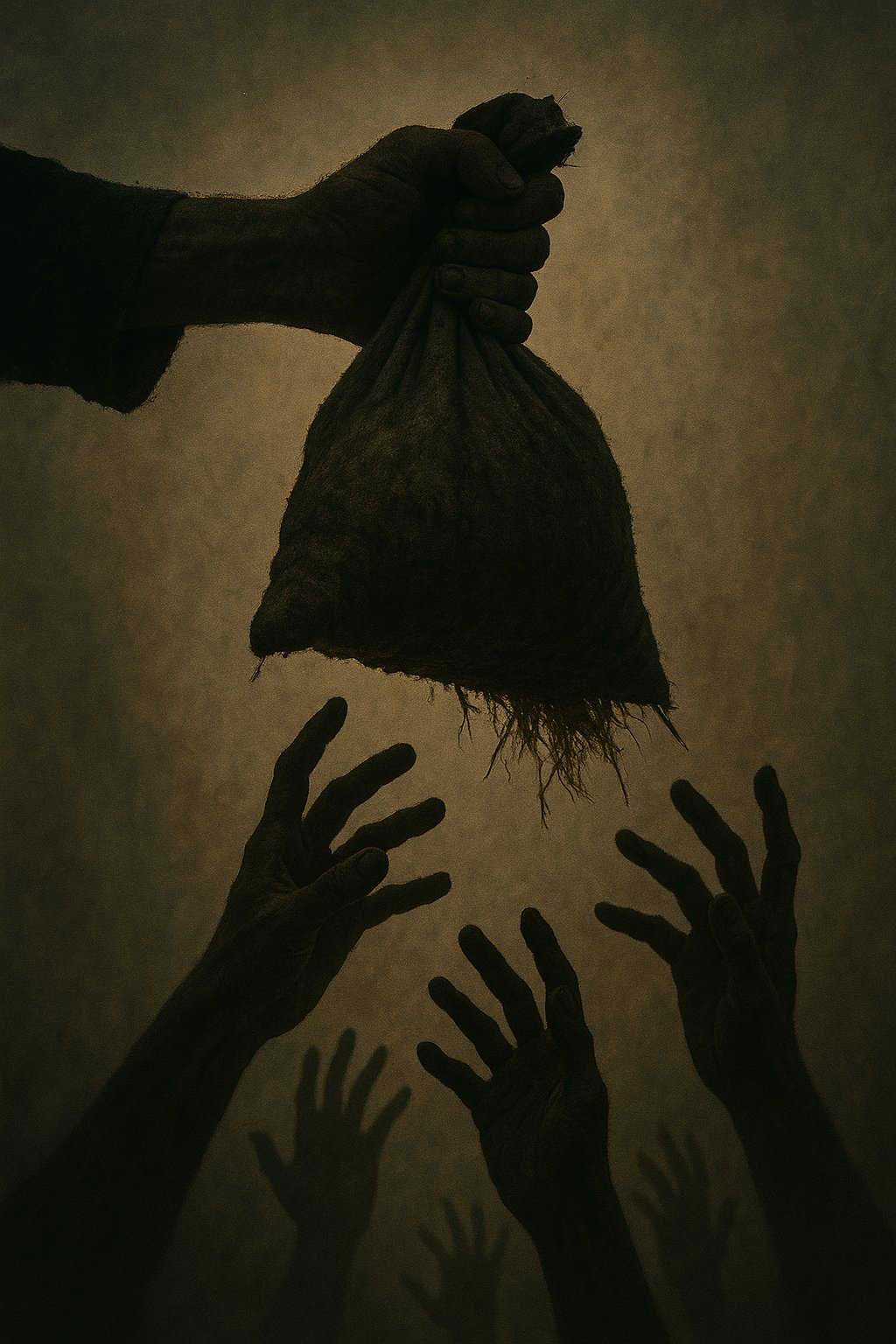
Lord Thornewood’s offerings—bags of used straw and sacks of
sawdust—were presented as benevolent gifts. But, in reality, they were mere
remnants of excess from the forest—a performance of care, not its substance.
Yet, these scraps felt like salvation to people stripped of basic necessities. Desperation has a way of distorting value, turning
paltry gestures into perceived lifelines.
"You asked for economic
reform; here’s a cash benefit and a civic holiday!"
Lord Thornewood’s brand of
manipulation thrives on deprivation. When scarcity becomes the norm, even the most meagre
relief can appear generous. The same pattern plays out across society: a modest
tax rebate, a temporary price incentive, a one-time bonus, or a refurbished
facility is framed as evidence of care and progress—offered in place of
meaningful reform or systemic efficiency.
The people ask for change—and instead, the system is
rebranded. The same structure, the same people, but now under a friendlier logo
and a polished slogan: “We’re building trust through transformation.” These
symbolic gestures are amplified through strategic messaging and presented as
proof that the leaders are listening—that the system is working.
But, these gestures often serve to distract from deeper
structural inefficiencies. They create a veneer of compassion that obscures
exploitation, keeping populations placated while meaningful reform is avoided.
Gratitude, in such contexts, becomes a tool of control—not a natural response
to generosity, but a manufactured emotion conditioned by false scarcity.
“They denied our request for health
benefits, but they gave us chocolates during Mental Health Week – thank you, our noble leaders!”
In Woodhollow, as in many societies, the true cost of these
tokens is invisibility: the ongoing needs that go unmet, the inefficiencies
that remain unchallenged, and the illusion that survival is a gift bestowed
rather than a right defended. These illusions persist because they are
constantly reinforced by subtle, repeated performances that suppress dissent
and reward obedience.
Occasionally, a voice breaks through: "Wake up, folks—those ‘gifts’ are just
your own wages re-gifted with a shiny ribbon!" But
such voices are often drowned out by the louder chorus of compliance.
When Bram dared to question the phantom threat, it wasn’t
only Lord Thornewood who responded—it was his fellow townsman, Garrin, who
quickly silenced him with, “Other towns have it worse.” Another
might have echoed, “Pay no heed to that doom-monger!” These
moments are revealing. Power sustains itself not just through command, but
through communal complicity. Fear and scarcity had worn down the townsfolk’s
resolve, subtly reshaping their loyalties. Gratitude became a civic duty, and
questioning? ...A betrayal.
This silencing of skeptics through peer pressure and shame
is one of the most insidious tools in systems of managed dependency. The
mechanism is psychological: those who challenge the narrative are branded as
disloyal, ungrateful, or even dangerous. Their voices are delegitimized not
necessarily through censorship, but through public disapproval and suspicion.
The community becomes the enforcer.
Such dynamics fuel a culture of self-censorship. People
learn to suppress their doubts, fearing ostracism more than inequality. This is
how groupthink takes root: not due to force, but through emotional
conditioning. Over time, the habit of silence solidifies, and questioning the
system feels riskier than enduring its inefficiencies.
In environments like Woodhollow, truth becomes less about facts, and more about alignment. To speak against the grain is to threaten the delicate illusion of order. And so, the illusion persists—safe, undisturbed, and unchallenged.
Lessons Beneath the Forest Floor
If a system exploits the people but
uses false generosity to
appear benevolent, it creates a polished illusion of social responsibility
while deepening the crises.
“Sure, we stand in the sun all day,
waiting to get one cupcake a day after we bake them. But hey, it’s free!
They’re so kind!”
Woodhollow’s desolate forest is more than a scene—it is a
mirror of the decay beneath the surface of systems managed by illusion. Once a
thriving forest, it now stands skeletal, overworked and unreplenished. This
mirrors the condition of societies that exhaust their people, resources, and
potential while projecting an image of progress. The real decay isn’t in the
trees—it’s in the decisions and priorities.
This reflects the broader phenomenon known as the
"resource curse"—wherein societies or communities rich in natural or
human capital paradoxically remain challenged. The curse, however, is not in
the lack of resources but in the structures of inefficiency, mismanagement,
greed, and performative leadership that divert those resources away from the
public good.
In environments like these, even the act of questioning
becomes dangerous. Calls for efficiency or accountability are often dismissed
as obstructionist or anti-progress. However, as Woodhollow shows us, progress
reduced to performance without accountability results in an impoverished system.
Three critical
insights emerge from the tale of Woodhollow:
Ø Accountability: Genuine reform demands openness—not only about
threats and challenges but about where resources go, who benefits, and how
decisions are made. Without transparency, systems cannot be trusted.
Ø Critical Literacy: Citizens must be equipped to recognize
manipulative generosity and symbolic reforms. Without this discernment,
societies are doomed to accept illusions as progress and suffer quietly while
change remains abstract.
Ø Community Stewardship: Empowering the people to manage their
resources is not just a safeguard against exploitation—it is a civic
responsibility. Stewardship demands that communities not only care for what
they have, but also ask questions, seek answers, and hold decision-makers to
account. When citizens are disengaged, abuse flourishes, and power remains in
the shadows.
Without informed and
empowered citizens, the most promising society can be hollowed out—just like
Woodhollow. As Paulo Freire observed, “True
generosity consists precisely in fighting to destroy the causes which nourish
false charity. False generosity constrains the fearful and subdued, the
‘rejects of life,’ to extend their trembling hands.”
Stewardship is not passive—it is participatory, demanding courage and
collective will.
Reclaiming the Forest
Imagine a Woodhollow where
the townsfolk reclaimed not just the woods, but their voice. Where the
people—no longer bowed to false scarcity or haunted by invisible enemies—walked
into the forest not as subjects, but as stewards. Imagine them gathering not to
plead for relief, but to deliberate and rebuild. In such a world, the Timber
Throne would be nothing more than a relic – weathered, abandoned, and with no
powers.
Reclaiming the forest means
more than recovering resources—it means recovering the narrative. It means
naming what’s in the shadows, questioning what was claimed, and gaining what’s
deserved. It means refusing the pageantry of empty gestures and instead insisting
on the substance of efficiency and shared power.
Woodhollow’s allegory is a
mirror. It reflects our political theatres, our workplace hierarchies, and our
civic structures. In them, we must ask: are we living in systems of shared
benefit, or are we applauding performances staged to keep us silent?
The power of illusion lies in its
repetition. But illusions crack when we stop repeating them.
And so, the question
lingers—not just for Woodhollow, but for us all:
Will we remain grateful for
sawdust, or will we demand the right to manage our woods?
The forest, after all, is still there—waiting for us.