


The Ironhold Tale
After the death of his father, the
throne passed to Lord Valor,
heir of the Kingdom of Ironhold.
His father had united the realms of Stonevale and Grainfield into one, forging
Ironhold as the strongest in the region. Yet one jewel had eluded his grasp:
the city of Brightwater.
Brightwater was a prize unlike any
other. Its fertile fields yielded great harvests. Its pastures raised incomparable
horses and livestock. Its seaport gleamed with fish and an assortment of
seafood. Its walls stood thick and unyielding, and its craftsmen were admired
across the kingdoms for their skills. Its people were proud of their language, history,
and culture; all distinct from Ironhold. They had no desire to bow to another
crown.
Lord Valor longed for what his father
could not have. But outright invasion of Brightwater was folly. Brightwater’s
weapons were sophisticated. To win by siege would bleed Ironhold dry.
Lord Valor turned to General Strongarm, a warrior
who is a descendant of a hero. People say he had the strength of twenty men,
and the wisdom of twenty more. When Lord Valor sought his counsel, he listened,
and then said quietly:
“My lord,
strength alone cannot always breach walls. But minds, when captured, will open
gates on their own.”
He proposed a plan, and Lord Valor
accepted.
Far upstream, Ironhold’s agents poisoned
Brightwater’s source of water in a way too subtle to suspect. Soon, the fish
and other seafood, Brightwater’s pride, culture, and lifeblood, fled from their
side of the river. Nets came up empty, markets shrank, and fear took hold.
Lord Valor offered help to Brightwater.
“Let your fishermen cast nets in Ironhold waters,” he proclaimed. “And let my
merchants sell your merchants fish at half their price, so that you still have
abundance and do not starve.” The people, desperate, accepted. To many, it
seemed proof that Lord Valor was no enemy, but an ally.
The trust opened doors for spies sent
into Brightwater to flourish: disguised as traders, artisans, scribes, and
wandering scholars. They mingled in the shops, befriended the nobles, flattered
the knights, and memorized the habits of the city’s rulers. They sent words
back to General Strongarm. They listed the names of influential men, the noble council's
leanings, and their vanities. For months, Brightwater’s weakness was mapped by
Strongarm and his men.
When the plan was perfected, Strongarm moved.
Ironhold’s army advanced and quietly encircled Brightwater with disciplined
silence. The soldiers positioned themselves at the gates and under the shadow,
cutting off any chance of alarm.
Inside Brightwater, the spies struck at
once. On a night of a festival, when the city’s guard was thinnest, they distracted
the sentries at the gates and the wall-watchers with a staged commotion at the
city center. Under the cover of this confusion, the nobles were lured into
wagons on the pretence of a council meeting with foreign envoys at Lord Valor’s
delight.
The gates opened not to an invasion, but
to let the wagons roll out with the nobles of Brightwater. Guarded by disguised
soldiers, the city’s leaders were driven past their own watchmen. By dawn, all the
nobles of Brightwater were at Lord Valor’s palace. Yet, no sword was raised
against them. Lord Valor received them with feasts and fine words.
“I have no
wish to harm you,” Lord Valor said. “I only ask for your loyalty. Speak well of
me, and your city will prosper under my reign. Resist, and your people will
suffer without you.”
The nobles, disarmed by comfort and
persuasion, yielded. Soon, their voices changed. Sir Caldor, a fierce knight, who
once resisted Lord Valor’s advances, declared openly to his people: “Lord Valor
is no tyrant. He is a protector.”
Edran, a scholar and scribe, once chronicler of Brightwater’s sovereignty,
wrote to the townsfolk: “To resist Lord Valor’s leadership is to cling to
shadows. To follow his leadership is to walk in the light.”
Lady
Miren, a wealthy merchant, told the markets, “I
have seen the generosity of Lord Valor with my own eyes. He is not here to
strip us of wealth, but to multiply it.”
Meanwhile, in Brightwater, the stories
circulated that their nobles had not been kidnapped, but they honoured a royal invite.
The militias, once ready to fight to the death, found themselves leaderless. They
laid down their arms. There was no battle, no siege, no blood spilled. They
accepted Lord Valor’s rule without resistance, convinced by the very voices
they have always trusted.
A token garrison watched the walls, but
little else seemed changed. The nobles of Brightwater did not return home, but instead,
remained in Lord Valor’s court, dressed in his colours, speaking with his wish. From there, they issued
decrees and counsel to their own people — words written in Lord Valor’s ink,
but spoken in familiar tones. The people trusted them, for they were the same voices
that once swore to defend Brightwater’s freedom.
In time,
the people said to themselves, “If our wisest and noblest now serve in Lord Valor’s
court, then surely, total submission must be wisdom.” So, they obeyed,
believing they were safe. Trade resumed, and life went on, but it was a life
quietly ruled by another’s hand: they never saw that
they had been conquered.
Brightwater
did not fall with the clash of swords or the roar of siege engines. It fell in
silence: through trust repurposed, loyalty redirected, and truth reshaped.
And so, Brightwater fell, not by the strength of arms, but by the surrender of minds.

Conquering
Without Swords
How Minds Become the New Battleground
The Ironhold Tale is a mirror
of how power is won and kept in modern times. In the past, armies stormed city
walls, revolutions overturned thrones, and foreign occupiers seized lands with
force. But, today, conquests often require no sword, no cannon, no visible
army. Instead, it unfolds quietly through the capture of minds.
In the story, Brightwater does not fall
to siege or bloodshed. It fell because its nobles, knights, and merchants; those
whom the people trusted, were captured first. Once their voices began to praise
Lord Valor, the people no longer saw themselves as conquered. They surrendered
without resistance, believing it was wisdom to do so. This is the power of
psychological operations (psyops): strategies that
shape perception until submission feels like choice.
Conquest is achieved when key voices:
leaders, experts, influencers, and institutions, are co-opted. Once they speak
with another’s agenda, the people follow, often without noticing the shift.
Soon, economies, food systems, education, healthcare, and even cultural beliefs
are guided by unseen hands.
The irony is that life may look normal. Businesses operate as usual, schools run, and events continue. Yet, beneath the surface, rights shrink, costs rise, and choices narrow. Like Brightwater, people may pay more for what they already have in abundance, but convinced it is the price of stability. They may even defend the very power that holds them captive.
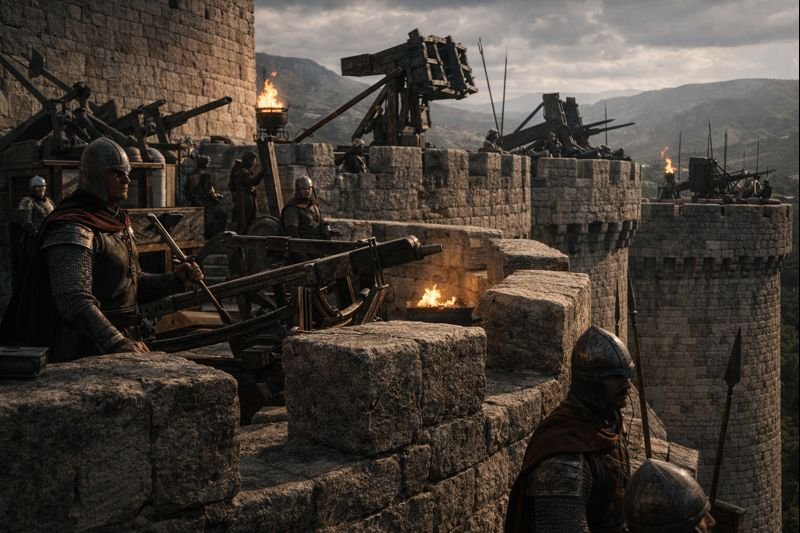
Capturing
Minds, Not Cities
The Subtle Steps of Psychological Conquest
In The Ironhold Tale, Lord Valor and his father desired
Brightwater, not simply for its beauty, but for its wealth and resources. Yet, they
knew force would fail. To march armies against strong walls would raise
suspicion, provoke resistance, and bleed the kingdom dry. Instead, the choice
was a quieter weapon: Psyops.
This strategy mirrors how power is often
seized. A government might impose policies that restrict rights, raise taxes,
or limit choices. Corporations may reshape markets through monopolies. Global
interests or globalists might introduce new financial systems. Pharmaceutical
giants may push the adoption of experimental treatments as necessities.
Technology firms may alter communication and culture with tools presented as
harmless. The methods differ, but the pattern remains: direct confrontation is
avoided, subtle capture is preferred. It follows a familiar sequence, one that
repeats across eras and contexts.
It begins with a problem construct. A crisis is
either manufactured or exaggerated to appear urgent and unavoidable. Narrative
framing ensures people see the issue as a threat beyond their control. In the
tale, Lord Valor poisoned the waters to drive away Brightwater’s fish. The
fishermen themselves, the local experts, could not trace the cause. Since human
involvement was not obvious, the people were left to blame nature, misfortune,
or even their own traditions. The true origin remained invisible and, therefore,
unchallenged.
The next stage is fear amplification. Anxiety,
confusion, and panic are cultivated until rational debate is weakened. In
Brightwater, empty nets created desperation. The fear of hunger primed the
people to welcome any hand extended in help. When Lord Valor offered fish at
half price, it looked like kindness. Fear made his aid feel like a rescue.
Then comes authority insertion.
Respected voices: nobles, scholars, experts, or influencers, are co-opted, and
their status lends legitimacy to the imposed narrative. In the tale,
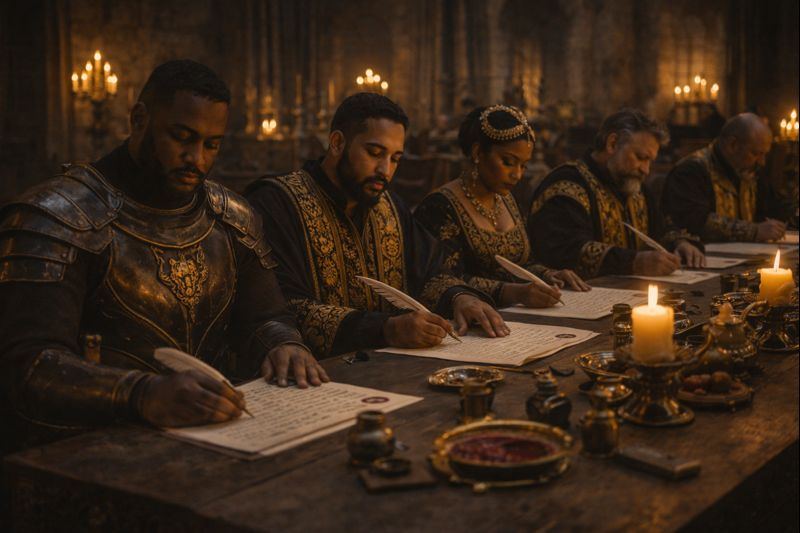
Brightwater’s leaders were lured away and persuaded with feasts and fine words.
These dealings happen outside the people’s view, under the guise of business agreements,
negotiations, and contracts hidden from public scrutiny. When the nobles emerged,
their words carried Lord Valor’s will. They may have reframed the crisis with
familiar reasoning, such as overfishing, the use of sophisticated tools that
frighten fish away, or poor practices. Because the voices are trusted, the
explanations are accepted without question.
This opens the way for controlled
guidance. The same figures now propose ‘solutions,’ presented as the only
logical or moral path, while alternatives are dismissed as foolish or
dangerous. Brightwater’s nobles might begin declaring that buying fish from
Ironhold was the wisest and most practical choice. Merchants would praise Lord Valor’s
generosity in offering supplies at reduced prices. Brightwater’s scholars would
argue that to resist would be to cling to shadows rather than embrace progress.
Any suggestion of restoring Brightwater’s own fishing system would be ridiculed.
Any dissenting view, if spoken, would have been dismissed as ignorant,
misguided, or even a conspiracy theory. In this way, dependence on Ironhold would
be framed, not as weakness, but as wisdom.
The process deepens with consensus engineering.
Repetition across platforms; whether through media, social institutions, or
social networks, creates the illusion that “everyone agrees.” In the tale, the
voices of Brightwater’s nobility, repeated and echoed, soon drowned out doubt.
Once a message is widely accepted, people comply, not only out of belief but
also under social pressure. To stand apart feels like isolation.
At this point, submission and compliance take
root. Resistance fades, not because people are convinced, but because they see
no alternative. Without leaders to rally them, the people lay down arms. People
submit to systems they cannot explain, policies they do not trust, and
ideologies they do not share, because experts insist it is for their good.
Social mechanisms enforce conformity: dissenters are shamed, excluded, or
punished. Even when most quietly disagree, a loud minority can create the
illusion that compliance is universal. This false consensus convinces the
majority they are alone.
Finally, there is normalization and institutionalization. The new order becomes embedded in systems, culture, and everyday life. Over time, the crisis that justified it is forgotten. What began as manipulation settles into permanence. People accept restrictions as natural, lack as inevitable, and authority as unquestionable. In Brightwater, life seemed normal again: events continued, businesses operated, but under a new crown they never chose.
The Power of
Expert Voices
Why Authority Capture Works
In The Ironhold Tale, Brightwater’s downfall began
not with armies but with its nobles and scholars. Once their voices shifted,
the people followed. The same principle explains why expert capture works so
effectively.
Experts, or those presented as such,
carry credibility. Their titles, platforms, and endorsements give the
appearance of trustworthiness. When a government, corporation, or interest
group secures their support, resistance weakens. Bills are passed with little
debate because “top economists” claim they are sound. Medical mandates gain
acceptance because “leading doctors” assure the public they are safe. Even
untested or questionable substances are justified on the grounds of “experts' approval,”
sometimes offered to poor communities as Aid.
This works because of authority bias, a cognitive
shortcut that leads people to overvalue expert opinions while undervaluing
their own judgment. If a respected figure declares a system as effective, many
will assume it must be true, even if the reasoning is flawed. People agree to a
practice because “the professional knows best.” Communities accept burdensome
taxes because “world leading bodies say it is necessary.” That is why even an
irrational or logically weak argument can be accepted because, “the presenter
sounds convincing.” Even when the people sense the flaws in the logic, they
surrender to it simply because it is from an “expert.”
The strategy also thrives on social proof and conformity.
When people see others obeying, they assume compliance is wise. Doubt fades
when it appears that “everyone agrees.” Just as the people of Dryden in the Echoes Behind the Wall Tale accepted
the illusion of endless rain because their neighbours believed it, societies
yield when repeated voices normalize an idea.
Finally, expert capture works because of
lifelong social conditioning.
From childhood, people are taught to respect authority figures, and warned
against disobedience. To challenge an expert feels dangerous, even shameful.
Fear of punishment, fear of exclusion, and the discomfort of standing alone
push people into compliance.
By capturing experts, powers do not
simply win arguments. They shape the frame of reality. Once trusted voices echo
the outsider’s voice, resistance feels not only futile but irrational.

Reflection
The fall of Brightwater should be a
reminder that the strongest walls are not made of stone, but of trust. Once the
voices people relied on are captured, resistance crumbles without a battle.
When we hand over our judgment to experts, or influencers without question, we
risk surrendering our freedom of thought.
Authority has its place. Wisdom and
knowledge are valuable, but blind obedience can become a trap. We must learn to
listen critically, to weigh information against our own reason and lived
reality. If something feels illogical or harmful, even when spoken by someone
with a title, it is worth pausing and asking: Does this truly make sense? Is there someone who
benefits if I believe this?
Self-awareness is the first defense. By
cultivating the courage to question and the patience to seek clarity, we
protect ourselves from becoming like Brightwater; conquered not by force, but
by persuasion.
The mind that refuses to be silenced remains the strongest gate against subtle capture.