
 The Chains of Witherbay
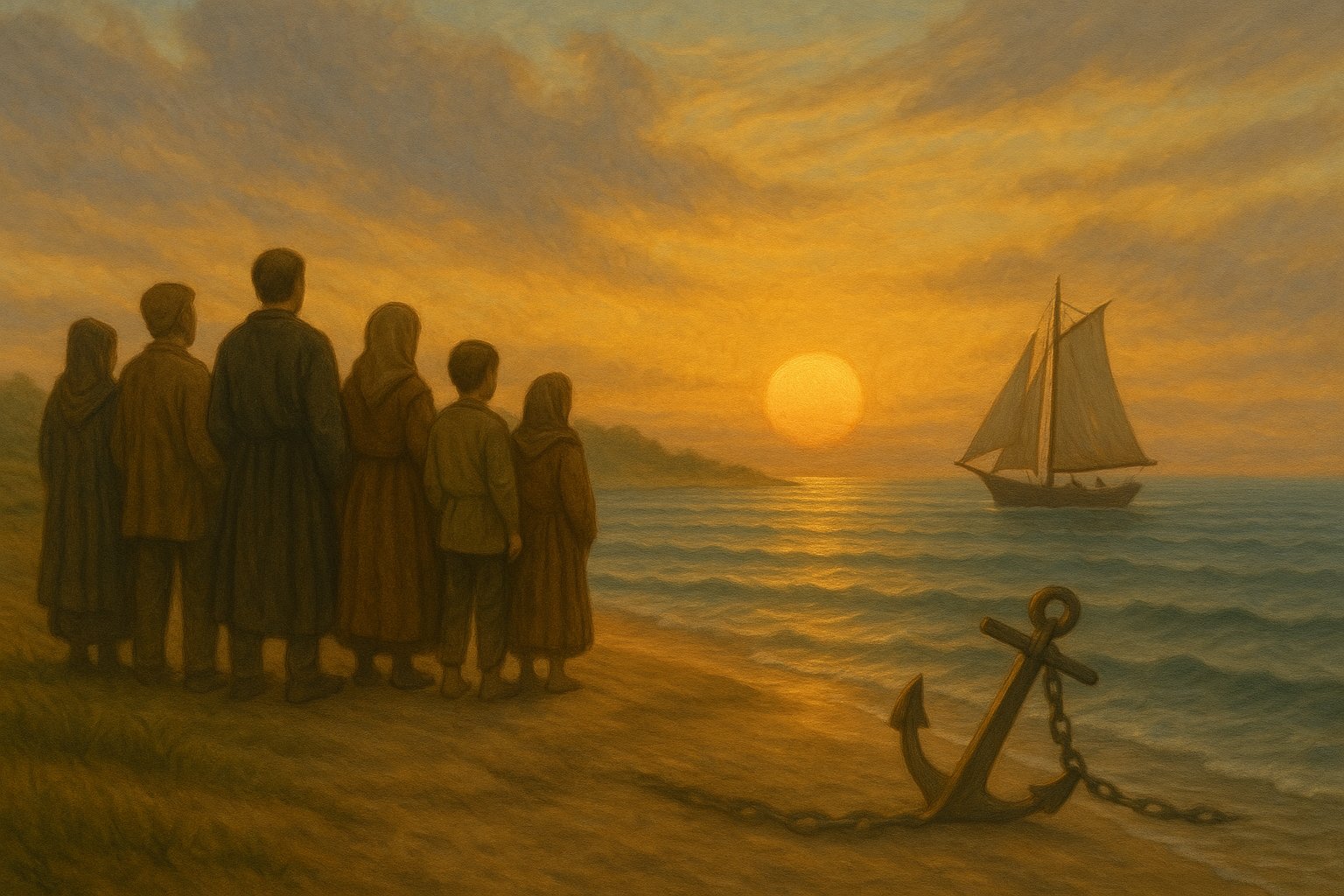
The town of Witherbay was a jewel in the
sea. Its plantations green, its plains radiant, its shores kissed by clear
waters. From a distance, it looked like a paradise. But its beauty was a prison.
The people were isolated from the vast mainland where markets, resources, and
riches lay.
Two master craftsmen, Aeron and Balen Oarstone,
were renowned for their boat crafts. Their fathers and forefathers had been boat
makers. A line of craftsmen stretching back as far as the elders could
remember. Each generation shaped wood with the same instruments, spoke the same
wisdom, and told the same stories passed on about the sea. Their boat craft was
not just a skill; it was an inheritance.
For centuries, the Islanders had sailed
the crafts of the Oarstones to fish and visit the edges of their small world.
But, they hardly crossed to the mainland. Many tried. Each voyage ended the
same way - midway across, heavy storms rose without warning, and waves
swallowed the boats, dragging crews into the deep. The unlucky drowned, and the
lucky washed back ashore on broken planks.
Over the years, whispers turned into
conviction.
“There is a
sea monster guarding the way,” the Islanders repeated.
And so, the tale became the norm. It was
told in gatherings, recited in festivals, and woven into songs. Plays were
performed to warn the young of foolishness. Survivors stood as ominous witnesses.
“I saw its
shadow. I heard its roar. None can pass,” the survivors would say.
Aeron and Balen, the expert boat makers,
nodded solemnly in assemblies.
“Our boats
are fine boats. But we are never meant for the mainland. Do not tempt death,”
they often recounted.
The belief grew so strong that anyone
who spoke of crossing was mocked as a dreamer, a fool, or a danger to the
community. Each year, an annual ceremony honoured the “brave but doomed.” Those
who tried and failed. Flowers were cast into the sea, not as a sign of hope,
but as a reminder that “The sea
cannot be conquered.”
The elders also tell of merchant ships
that sometimes stop to trade, and as an act of kindness, would offer to take an
Islander across to catch a glimpse of the mainland. Years later, when the ship
returned, so too would the Islander. And so, the people learned to wait for the
chance of a passing ship.
One day,
two young Islanders, Cael and Doran, began to ask questions. They said among
themselves as they watched a merchant ship far away at sea.
“The
merchants’ ships pass these waters,” Cael said. “The elders tell us of sea
monsters, but how do the ships come and go so freely?”
It was as though a long-locked gate gave
way in Doran’s mind, and he said,
“Perhaps it was
not monsters, but the weakness of our boats. If their ships could endure, then
maybe stronger boats could carry us too.”
They then proposed building a vessel
larger than any Aeron or Balen had crafted, reinforced with timber and fitted
with floating devices to keep it steady.
The townsfolk laughed, and said:
“Madness!” “Even
Aeron and Balen could not succeed; who are you to try?”
“Did not the survivors tell us what awaits?”
Still, Cael, Doran, and a small team built.
They toiled by the shore, gathering timber, shaping beams, ignoring ridicule.
People visited just to scorn.
“Better to
dig your own graves here than at sea,” the mockery rang out.
But at last, the day came – Cael, Doran,
and a small team set sail, and the town mourned them as though already dead.
The storm struck, but their boat, heavy
and wide, endured. The waves broke against it, but it did not break. Days
later, they saw the mainland. Weeks later, they returned, bringing goods, materials,
and fabrics that the Islanders had always dreamed about.
The people gasped. For a moment, hope
flickered.
But the elders, Aeron, Balen, and some
of the survivors shook their heads, insisting:
“It was a
trick of chance.”
“The sea
monster must have slept.”
“The currents
shifted.”
“Perhaps, the
sea let them pass only to trap others; do not be deceived.”
Eager for the comfort of their old fear,
the people nodded in agreement. They dismissed Cael and Doran as lucky fools.
Songs were updated:
“Yes, some returned, but only by chance. To try again is
still death.”
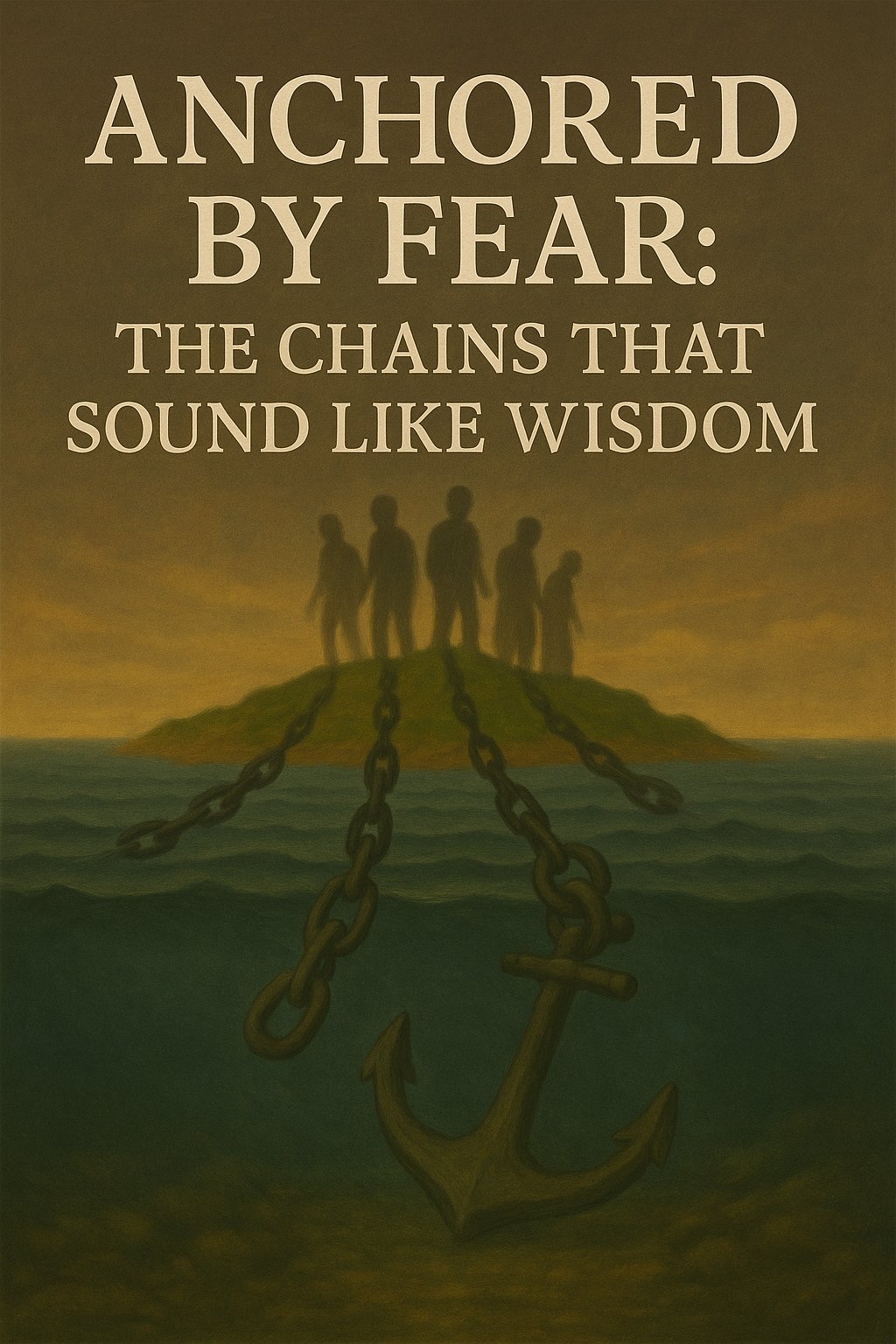
And so, Witherbay remained what it had
always been—a green Island bound in invisible chains. Surrounded by the beauty
of the sea, its people chose to stay isolated. Not because they could not cross
the sea, but because they believed they could not.
The craftsmen, the elders, even the
survivors all knew, deep down, that if they ever supported the building of
bigger boats or ships, the Islanders would cross the sea freely.
But, they would rather feed their fears than feed their hopes, because fear had become safer, easier, and far more familiar than freedom.

 When Fear Becomes Familiar
The Chains of Witherbay tale is a story
about learned helplessness.
This happens when people begin to believe they have no control over their
situation, even when they actually do, because their past efforts to change
things were unsuccessful. After several failed attempts, they stop trying
altogether, telling themselves,
“Why bother? Things can’t change. Just accept,
consume, and adapt.”
At first, it is not always obvious. It
shows up in the way people make decisions about important issues that affect
their lives. Slowly, they give up their power and agency. They begin to think
their judgments do not matter, so they let others decide for them. Over time,
they lose confidence, become passive, and start waiting for someone else to
take action. This loss of motivation often accompanies negative self-talk, such
as,
“We can’t do this,” or “I’m not good enough.”
Learned helplessness develops over time in environments that reinforce it. People who
once showed resilience begin to give up quickly because they expect failure.
The constant thought of defeat weighs heavily on their conversations, and their
energy for change fades. They adapt, but not by overcoming. They adapt by
surrendering to the situation.
This is precisely what happened on the
Island of Witherbay. A land full of promise and beauty, but cut off from the
mainland and its riches. The storm, or the perceived monster, became the symbol
of a system too potent to fight. Each failed attempt to cross the sea reinforced
the people's conviction that it was impossible. The story reflects different
situations, such as resisting injustice, facing an economic crisis, breaking a
bad habit, or even trying to lose extra weight.
The experts, in this case, the boatmakers,
elders, and survivors —people the community trusted —reinforced the idea that
nothing could change. Their words and authority strengthened the conditioning. Festivals,
songs, and entertainment, including media, helped sustain the belief. Even when
Cael and Doran succeeded, their victory was dismissed as a chance. The system
of fear remained stronger than the proof of freedom. That is the paradox of learned
helplessness. Possibilities exist, but people cling to the comfort of fear.
For instance, elites may boast openly of subverting the people’s will, manipulating elections, silencing dissent, or stripping people’s rights. Yet, the people would share the clips as memes, laugh or grumble in private, and take no action. Either because they are afraid to act, or because they are convinced that nothing will change. However, real change begins the moment we choose not to wait for others, but to act for ourselves.
 The Comfort of the Cage
How Learned Helplessness is Sustained
Learned helplessness does not exist in isolation; it is sustained by systems and
agencies that enable it to thrive and grow. Almost every social institution
either dismantles or reinforces the conditioning that keeps people powerless. Examining
these agencies closely helps us understand how learned helplessness is
maintained and how we might overcome it.
One of the strongest agencies that sustains
it is the learning system. Education is meant to equip the mind to address
life’s challenges, but when learning — whether in school, at home, or in other
settings — discourages questioning, it conditions people to accept what they
are told without challenge. A system that rewards obedience and memorization
over critical thinking teaches people not to question or challenge ideas or
norms. Paulo Freire described this as the “banking system” of learning, where
knowledge is deposited and withdrawn, rather than questioned and created. In
such an environment, learned helplessness develops because people are
conditioned to comply rather than to think creatively and imagine new
possibilities.
The media is another powerful agency. It
often reinforces what the learning system has planted. Constant cycles of
similar stories of crime, disasters, and division make the world appear
dangerous and unchangeable. By repeating stereotypes, the media can lead people
to believe that the status quo cannot be altered. It also promotes the “experts
only” framing, where ordinary people are told that they cannot understand basic
economics, politics, psychology, or health without the guidance of specialists.
This discourages self-empowerment and critical thinking.
In the Witherbay tale, the boatmakers and
the survivors dismissed Cael and Doran’s ideas because they were not the
recognized “experts.” And if the experts say we can’t, then they must be right.
Social media takes this further. Its
algorithms prioritize content that reinforces existing patterns, and people are
conditioned to consume rather than to question. Cancel culture and online
pile-ons instill fear in individuals, discouraging them from speaking out on
the issues. Instead of becoming active participants, people become passive
observers. Change is equated with virality: only what trends seem to matter.
Someone making small, consistent changes in their life is often ignored or even
ridiculed, because they are not “going viral.” In this way, social media shifts
focus from agency to spectacle.
The entertainment industry also plays a
role. It amplifies what learning agencies and media sustain, glamorizing elites
while portraying ordinary people as powerless or dependent on heroes. This
normalizes the belief that change is only possible for a chosen few and that rescue
comes from outside. Entertainment also nurtures escape culture. Endless
“binge-worthy” shows and content, which provide distraction instead of
empowerment, teach people to numb frustrations instead of confronting them.
All of these agencies work together to
condition people to accept their situation as ideal. The framing is powerful
because it shapes what feels natural. People begin to comply, to accept, and to
believe that no change can ever come from within. In the Witherbay story, the
narrative glorified the rare visits of the merchant ships, reinforcing the idea
that only outside help could bring hope. We begin to internalize views such as:
“Our people
can’t succeed within this...”
“We want a
good life, but not the work that builds it.”
“Our
community is too broken to fix.”
“Change is
impossible because a parasitic, warped ideology already consumes us; it’s who
we are now.”
Some societies still wait at the shore,
convinced that rescue will sail in with gifts bound in chains, such as aid. Yet,
real change begins not with foreign ships, but with the courage to build within
our own Islands.
 The
Cycle Within
The
Cycle Within
From Individual Struggles to Community Traps
The effects of learned helplessness start
at the individual level. A worker who is repeatedly passed over for a promotion
may stop trying, even after improving their skills. A person who has tried and
failed to lose weight may resign themselves to being unhealthy. A young person
who grew up on superhero stories may internalize the belief that problems can
only be solved by extraordinary individuals, rather than through ordinary
effort. Some stay in toxic environments, convinced there is no escape. Others
stop learning new skills because they assume they will fail before they even try.
Even minor setbacks, such as failing a test or struggling with a new technology,
reinforce the cycle of helplessness if the conditioning is strong enough.
When the effect of learned helplessness
is multiplied across a community, these individual choices become collective
patterns. Societies constantly exposed to cycles of poverty, crime, and
victimhood begin to believe that nothing will ever change. The refrain becomes:
“Nobody cares. Why try? The last time someone
stood up, they were silenced.”
Others come to believe that only by
being loud or controversial can they make an impact, because that is what the
media rewards.
A system that tells the poor and
vulnerable that their only hope lies in handouts further deepens this mindset.
Instead of joining with change agents to create solutions, people retreat into
waiting for the next handout or miracle. In Witherbay, rather than working with
Cael and Doran to build a stronger boat, many continued to dream that the
merchant ship might one day take one of them to see the mainland.
Learned helplessness persists because these agencies — learning, media, and entertainment — condition people to believe that power lies elsewhere, never within themselves. The challenge begins when individuals recognize these patterns and choose, like Cael and Doran, to act, despite the voices that say, “It cannot be done.”

 Building Stronger Boats
Choosing Agency Over Fear
Learned helplessness is not a life
sentence. It can be resisted, unlearned, and replaced with courage. Like Cael
and Doran, we can choose to build differently.
The first step is to challenge the old and
existing stories. We must ask: Who
benefits from my believing this? Refuse the narrative of
inevitability and rewrite the narrative in your mind.
Change doesn’t need viral waves. It begins
with small, consistent steps. Own your agency, every action matters, and
recognize that no miraculous ship is coming.
Reframe failure, not as proof of doom,
but as a lesson for the next voyage. Stronger boats are built from the wrecks
of old ones if we are willing to learn.
Rephrase your self-talk. Notice where you say “they” instead of “we,” or “we” instead of “I.” Agency begins when you claim responsibility for what you can do. Change multiplies when belief is shared, but it always starts with the courage to act.
 Reflection
The greatest tragedy of Witherbay was
never the storm or the sea monster. It was that the people chose to believe
fear over freedom. They mocked hope because it unsettled the comfort of their
caution.
Yet, learned helplessness is not
permanent; it can be unlearned. The Cael and Doran who dare to try again prove
that storms are not destiny. The sea may be vast, but it is not unconquerable.
Change begins with those willing to build, to endure ridicule, and to show that
the impossible can be done.
Fear keeps helplessness alive; action
makes it die. The storms we face may feel overwhelming, the obstacles real, yet
the story we tell about them often matters more than the challenge itself.
The choice is always ours: remain
ashore, clinging to fear, or step forward to build and to sail.
Only when we sail will we discover that freedom was within reach all along.